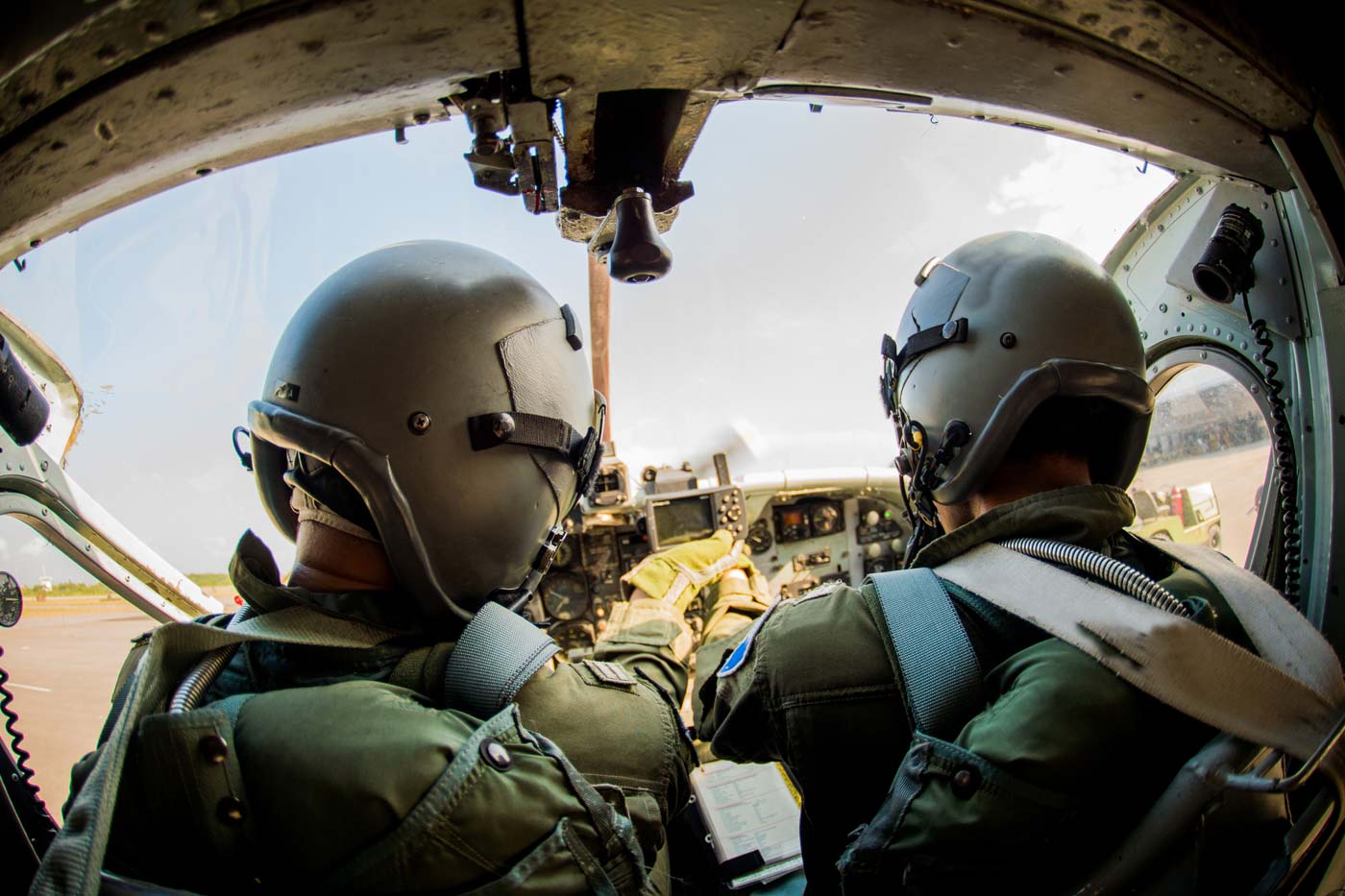
After being commissioned as an Army officer, I was serving as a first lieutenant when I made an important decision: I would apply to become a helicopter pilot by changing my military specialty. The thought of becoming one of the Army’s relatively few helicopter pilots and soaring freely through the skies filled me with excitement, especially in an army whose primary operations take place on the ground.
Competition was fierce, but my persistent efforts paid off when I passed the first stage of selection for the Aviation Warrant Officer Training Program and began intensive training. At the time, I had no idea just how much rigorous training and demanding instruction it would take to fly a helicopter weighing several tons hundreds of meters above the ground, maneuver it freely, and carry out missions.
To become a pilot, one must undergo at least 100 hours of training, covering everything from basic helicopter controls to tactical flying that requires extensive knowledge. Even the simplest exercises are practiced over and over again. During an operation, even the slightest mistake or error in judgment could endanger not only my own life but also the lives of everyone on board. Naturally, the instructors had to be strict. With so much to learn and under constant pressure, hearing harsh and cutting words day after day sometimes left me feeling hurt and powerless.
“Is all this really necessary?”
Even though I understood that the instructors had little choice but to be strict for everyone’s safety and the successful completion of our missions, I still could not shake feeling of resentment. That feeling remained until the day I took to the skies alone, without an instructor by my side.
After completing the required practice flight hours, every trainee must go through an unavoidable rite of passage: a solo flight. During this flight, the trainee must take off alone, fly a designated route, and land without anyone’s help.
During training, even if I made a mistake, I might get scolded by the instructors, but at least I had a chance to correct it. When flying alone, however, I might not even realize that I had made a mistake. Even before the flight, I was gripped by the fear that a single wrong move could cost me my life.
It was only after flying alone in such fear that I finally understood the instructors’ attitude. The pressure I had felt during training was nothing compared with what I experienced during that solo flight. I was extremely nervous, yet everything the instructors had taught me over and over again—hundreds of times—had already become second nature and came to me almost instinctively. Even the knowledge I had not fully understood during training finally became my own as I made each decision and maneuvered the aircraft by myself. I came to realize that there was not a single part of the grueling, difficult, and tedious training process that was without reason or importance.
Even after becoming a fully qualified pilot, I continue to carry out my duties with everything I learned during training firmly in mind. In fact, I now have even more to check and learn. The preflight checklist alone is as long as an entire book. Simply memorizing it or taking shortcuts is never acceptable. The rule is to open the checklist and thoroughly go through every item, one by one. This is an essential procedure for ensuring the safety of everyone on board and the successful completion of the mission. Ignoring regulations because they seem inconvenient or because there is not enough time could result not only in failure to complete the mission but even in disaster.
Once all the necessary preparations are complete and a pilot takes to the air, the only thing to rely on is the flight instruments. This is especially true in severe weather. Experienced pilots often give this advice: If you encounter weather so severe that you cannot see in any direction, never trust your own senses. Keep your eyes on the instruments, climb straight ahead, and get out of the dangerous conditions. When visibility is lost, our senses can become unreliable, creating sensory illusions and spatial disorientation. At such times, we must follow the precise instrument readings rather than rely on our own experience or instincts in order to escape the danger. I believe this is why we are taught and trained over and over again from the time we are trainees—so that if we encounter such a situation even once among the countless flights we will make before our military service ends, we can respond calmly and wisely.
From basic training and actual flights to learning how to handle dangerous situations, there are many spiritual lessons to be drawn from flying. The words God has given His children in the Bible are like a checklist and flight instruments that safeguard our souls. The prayer, worship, and preaching we practice repeatedly are like training that helps us fulfill the sacred mission of leading God’s children to salvation and arrive safely in the kingdom of heaven.
We must never neglect God’s word, thinking, “I know enough now,” or “I have plenty of experience.” Instead of relying on our own knowledge and experience, we should diligently study God’s word, examine our faith, and faithfully put His teachings of life into practice. If we do so, I believe we can successfully complete our flight toward the kingdom of heaven.
I give heartfelt thanks to God Elohim for granting me the lessons I truly needed through my military service. As an officer in the Republic of Korea Army, I will faithfully adhere to the fundamentals in every flight and mission as I protect our airspace. And as a soldier of God, I will share the good news of salvation with many people.
Captain Kim Dae-yeon from Paju, Korea
1
Bookmark
Share
주소가 복사되었어요.